Buying an Apartment in Barcelona to Renovate: A Guide for Foreign Buyers

Quick answer: Buying an apartment in Barcelona to renovate is open to any foreigner — there are no nationality restrictions, and the only document you must have is an NIE. Budget 12–15% on top of the purchase price for taxes and fees, most of it Catalonia’s ITP transfer tax at 10% on the first €600,000. The “100% tax” on non-EU buyers announced in January 2025 is still not law as of September 2026. And if you intend to renovate, the most valuable check happens before you sign: the building, not just the flat.

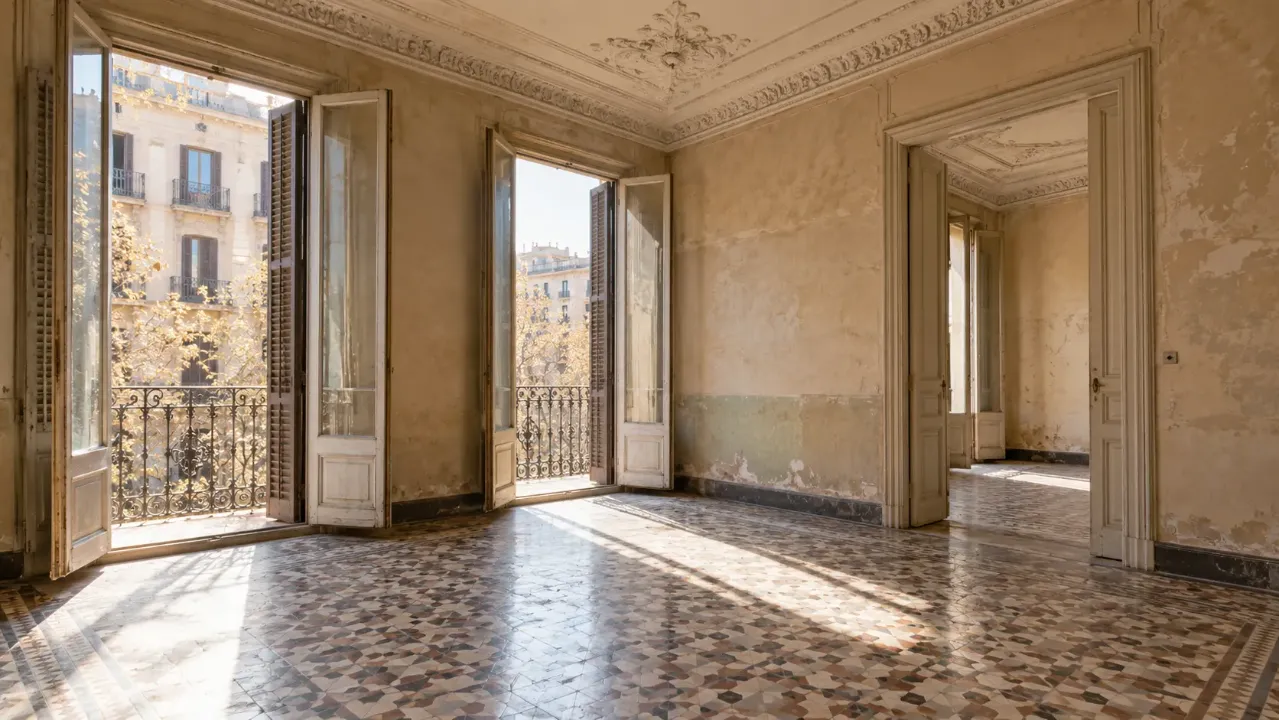
Buying an apartment in Barcelona to renovate: empty Eixample flat with high ceilings, hydraulic tiles and balcony doors before works
Home » Guides » Buying an Apartment in Barcelona to Renovate: A Guide for Foreign Buyers

An old flat with high ceilings and tired installations can be the best purchase on the street, or a €40,000 problem. The difference is rarely visible on the viewing: it sits in the building’s inspection report, the community’s accounts and the position of the soil stack. Most buying guides stop at the keys. This one is written from the renovation side: the purchase itself, then the technical due diligence to run before the deposit contract. If you already own and want the works handled, see our apartment renovation service in Barcelona; for everything we do, see our home renovation services in Barcelona.

Key Facts at a Glance

No restrictions on foreign buyers. EU, UK, US or anywhere else: you need an NIE, a Spanish bank account and, ideally, an independent lawyer.
ITP is 10% up to €600,000. Since 27 June 2025 Catalonia taxes second-hand homes on a progressive scale: 10% to €600,000, then 11%, 12% and 13% on the portions above.
Total purchase costs run 12–15%. ITP plus notary, land registry, gestoría and a lawyer: roughly €40,000 on a €350,000 flat.
The “100% tax” is not in force. The bill was filed in Congress in May 2025 and, as of September 2026, has not had its first plenary vote.
The golden visa ended on 3 April 2025. Buying property no longer grants any residency right in Spain.
Check the ITE and the derramas before the arras. An adverse building inspection or an approved special levy becomes your bill the day you complete.

Can Foreigners Buy Property in Barcelona?

Yes, with no nationality restrictions, as a resident or a non-resident. Practically you need three things: an NIE (Número de Identidad de Extranjero), a Spanish bank account to pay taxes and utilities, and an independent lawyer who does not work for the seller or the agency.

01

The “100% tax on foreign buyers”: what is actually true

In January 2025 the Spanish government announced a new state surcharge, the Impuesto Complementario Estatal sobre las Transmisiones Inmobiliarias, of up to 100% on home purchases by non-EU, non-resident buyers.

As of September 2026 it is not law. The measure sits in a bill filed by the Socialist parliamentary group on 22 May 2025 (Proposición de Ley 122/000196). According to the Congreso de los Diputados, the bill is still awaiting its first plenary vote (toma en consideración); no version has been debated or voted on.

In practice, foreign buyers purchase under exactly the same rules as before the announcement. The proposal could return in a modified form, but it would only ever affect non-EU, non-resident buyers.

02

The golden visa is gone

Spain’s “golden visa”, residency in exchange for a €500,000 property investment, was abolished with effect from 3 April 2025 by Ley Orgánica 1/2025. Buying property no longer grants any residency right. If residency matters to you, it needs a separate route (work, non-lucrative or digital-nomad visa), independent of the purchase.

What Buying Actually Costs: Taxes and Fees

The price on the listing is not what leaves your account. In Catalonia, budget 12–15% on top.

ITP: the big one

Buying a second-hand home in Catalonia means paying ITP (Impuesto de Transmisiones Patrimoniales), not VAT. Since 27 June 2025, under Catalonia’s Decreto-ley 5/2025, the tax follows a progressive scale. Each rate applies only to the portion of the price within its band:

Portion of the priceITP rate
Up to €600,00010%
€600,000 – €900,00011%
€900,000 – €1,500,00012%
Above €1,500,00013%

Most Barcelona purchases fall entirely in the first band, so 10% is the working figure. A 20% rate applies when the buyer is a gran tenedor (broadly, more than ten dwellings, or five or more in a stressed-market zone). A reduced 5% rate exists for buyers aged 35 or under, large families, single-parent families and buyers with a disability purchasing their habitual residence, subject to income limits; it rarely applies to overseas buyers. The full scale is published by the Agència Tributària de Catalunya.

A trap worth knowing: since Ley 11/2021, the taxable base is the higher of the purchase price and the valor de referencia, the official reference value set by the Catastro. Negotiate a price below that value and you are still taxed on the higher figure. Anyone can check it free on the Sede Electrónica del Catastro before agreeing a price. ITP is filed on Modelo 600 within one month of the deed.

Buying new-build instead? Then it is 10% VAT plus 1.5% AJD (stamp duty) rather than ITP.

The rest of the costs

ItemTypical cost
Notary€600–€1,200
Land registry€400–€900
Gestoría (tax filing and registration)€300–€600
Independent lawyerAbout 1% of the price
Mortgage (if any)Valuation plus arrangement fee
Pre-purchase technical survey€300–€800, optional and recommended

Illustrative example, a €350,000 flat in Gràcia: ITP of €35,000, around €2,000 for notary, registry and gestoría, and around €3,500 for the lawyer. Roughly €40,500 in costs before renovation.
Budget the Purchase and the Renovation Together

The most common mistake we see: buyers spend to the top of their budget on the flat, then discover the renovation costs €70,000 they no longer have. Work backwards instead:

Total budget = purchase price + 12–15% purchase costs + renovation + 10% contingency

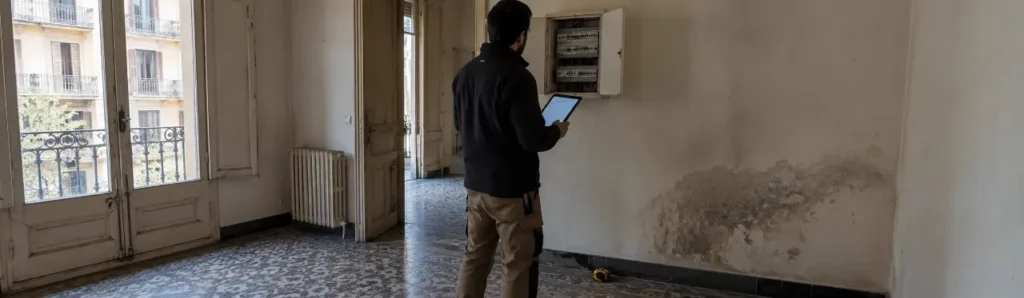
Surveyor checking the electrical panel and a damp patch in an old Barcelona apartment before purchase

AI-modified image

As a planning figure, a full renovation in Barcelona runs €600–€1,700 per m² depending on finish level, so an 80 m² flat is typically €48,000–€112,000 in building work, before VAT and permits. Our apartment renovation cost guide breaks this down by size and tier, and our kitchen renovation cost guide covers the room that moves the budget most. If you are buying an apartment in Barcelona to renovate, reserve 20–30% of your total budget for the works. A cheaper flat that needs more is often a better outcome than a pricier one you cannot afford to finish.

Two tax points for investors. Renovation work is taxed at 10% VAT only when the client is a private individual using the flat as a home, the building is over two years old and contractor-supplied materials stay under 40% of the bill, per the Agencia Tributaria. A flat bought to let pays 21%: on an €80,000 renovation, an €8,800 difference. And Barcelona’s energy grants require the flat to be someone’s registered main home, so an empty second home does not qualify; see our guide to energy-efficient renovation for non-resident owners.

What to Check Before Buying an Apartment in Barcelona to Renovate

Run through all of this before you sign the contrato de arras (the deposit contract). After that, walking away costs you the deposit.

The building, not just the flat

The nota simple

Request it from the Registro de la Propiedad. It confirms who legally owns the property and any charges, mortgages or embargoes attached to it. Never rely on the seller’s word.

The ITE

In Catalonia every residential building must pass a technical inspection (Inspecció Tècnica de l’Edifici) before it reaches 45 years of age, under Decret 67/2015, as set out by the Agència de l’Habitatge de Catalunya. Ask whether the ITE is current and what it flagged. An adverse report can oblige the community to carry out façade, roof or structural works, and the new owner inherits that bill.

Community debts and derramas

Request the certificate of outstanding community fees and ask the administrator about approved or planned special levies (derramas) for lifts, façades or roofs. These can run to tens of thousands per flat and are frequently the largest hidden cost in a Barcelona purchase.

The flat itself

01

Cédula de habitabilidad

The habitability certificate is required to transfer a home and to contract utilities; a second-occupation cédula is valid for 15 years, per the Generalitat de Catalunya. Check that one exists and is in date. If you plan to change the layout, read our cédula de habitabilidad guide first.

02

Protected or heritage status

Many buildings in Ciutat Vella and the Eixample carry heritage protection, which can restrict façade changes, window replacement and some interior alterations. Verify it before you plan anything structural; our Barcelona renovation permits guide explains which permit each type of work needs.

03

Load-bearing walls

The open-plan layout you have in mind may involve a structural wall. That is not a no, but it means a technical project, structural calculations, a steel beam and a structural permit (a comunicat diferit for a single wall in Barcelona, a major-works licence beyond that), and roughly €10,000 or more on top.

04

Electrics and plumbing

Old aluminium wiring, no earthing, a low contracted supply and lead or galvanised pipework are common; a full rewire and new pipework are normal in an unrenovated flat. Check where the soil stack runs, because it dictates where kitchens and bathrooms can realistically go.

05

Damp and ventilation

Look for staining at skirting level, on party walls and around interior patios. Damp in older Barcelona buildings is common and fixable, but it needs proper diagnosis and often thermal and acoustic insulation work.

06

Original features

High ceilings, mouldings, vigas and hydraulic tiles are worth preserving: they add real value and are expensive to replicate.

None of these findings is automatically a deal-breaker when buying an apartment in Barcelona to renovate. Each one is a negotiating lever, if you find it before you sign.

The Buying Process, Step by Step

1. Get your NIE

and open a Spanish bank account.

2. Appoint an independent lawyer

not one recommended by the selling agent.

3. Search and view

with renovation potential in mind.

4. Technical check

by a renovation company or surveyor before you commit.

5. Offer and arras

usually with a 10% deposit. The point of no return.

6. Due diligence

nota simple, ITE, community debts, cédula, heritage status.

7. Deed (escritura) before a notary

a poder notarial lets your lawyer sign if you cannot travel.

8. ITP

on Modelo 600 within a month, then registration and utilities.

9. Renovation

permits first, then works.
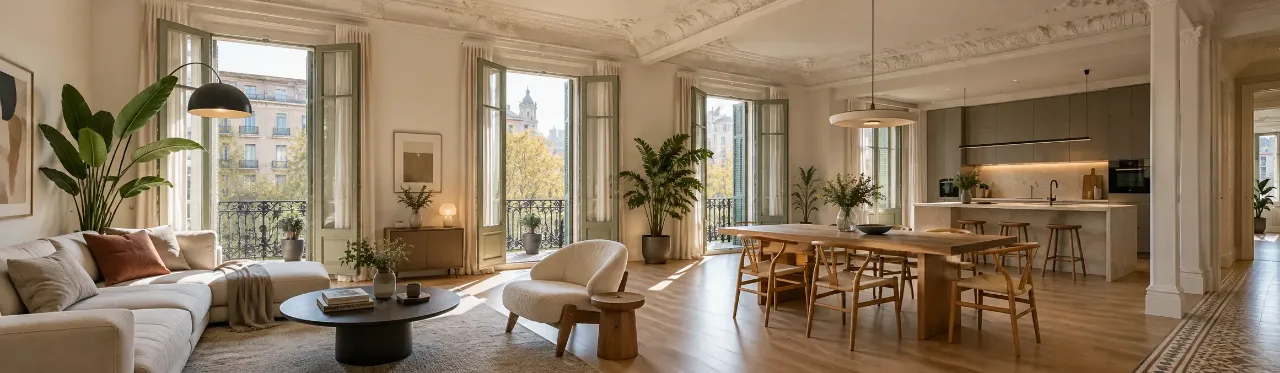
Between the arras and the deed you will typically have 4–8 weeks: the ideal window to get the renovation designed and quoted, so works start soon after completion.

AI-modified image

Renovating After You Buy, Especially From Abroad

Most of our clients buy in Barcelona while living somewhere else. What makes that work: design and quote during the arras window, so permits are filed the day you complete; one managed team for permits, trades and delivery; staged payments tied to milestones, never a large sum upfront; photo and video updates, including every wall before it is closed up; and your VAT position confirmed in writing before signing the works contract.

That is how our renovation service for expats in Barcelona runs. If you are comparing firms, our checklist for choosing a renovation company covers the registrations and insurance to verify, and our renovation projects show finished flats.

Common Questions

Sources & References


· Agència Tributària de Catalunya — ITP scale, 20% large-holder rate and 5% reduced rates: atc.gencat.cat

· Boletín Oficial del Estado — Decreto-ley 5/2025 (progressive ITP): boe.es · Ley 11/2021 (valor de referencia): boe.es · Ley Orgánica 1/2025 (end of the investor visa): boe.es

· Sede Electrónica del Catastro — valor de referencia lookup: sedecatastro.gob.es

· Congreso de los Diputados — Proposición de Ley 122/000196 (proposed surcharge on non-EU buyers) and its status: congreso.es

· Agencia Tributaria — VAT on works in dwellings (10% vs 21%): sede.agenciatributaria.gob.es

· Agència de l’Habitatge de Catalunya — ITE (Decret 67/2015): habitatge.gencat.cat · cédula de habitabilidad (valid 15 years): tramits.gencat.cat

· Colegio de Registradores — nota simple: registradores.org

Tax rates, thresholds and fee ranges are for planning purposes and depend on your circumstances; the status of the proposed surcharge is as at the date below. Renovation figures follow our apartment renovation cost guide and exclude VAT and permits. This article is not tax or legal advice: take independent professional advice before buying. Last updated: September 2026.

Thinking of Buying a Flat in Barcelona to Renovate?

The best time to talk to a renovation company is before you buy. Send us the listing and we will tell you what the renovation would realistically involve and cost, so you can negotiate with real numbers.

Scroll to Top