How to Choose a Renovation Company in Barcelona: A Checklist for Overseas Owners

Knowing how to choose a renovation company in Barcelona is harder when you are not in Barcelona. You cannot drop by the site, you cannot read the paperwork in your own language, and you cannot sit in the meeting where decisions get made. Most owners compensate by comparing prices — which is exactly the wrong instinct, because the cheapest quote is usually cheap for a reason you cannot see from abroad.

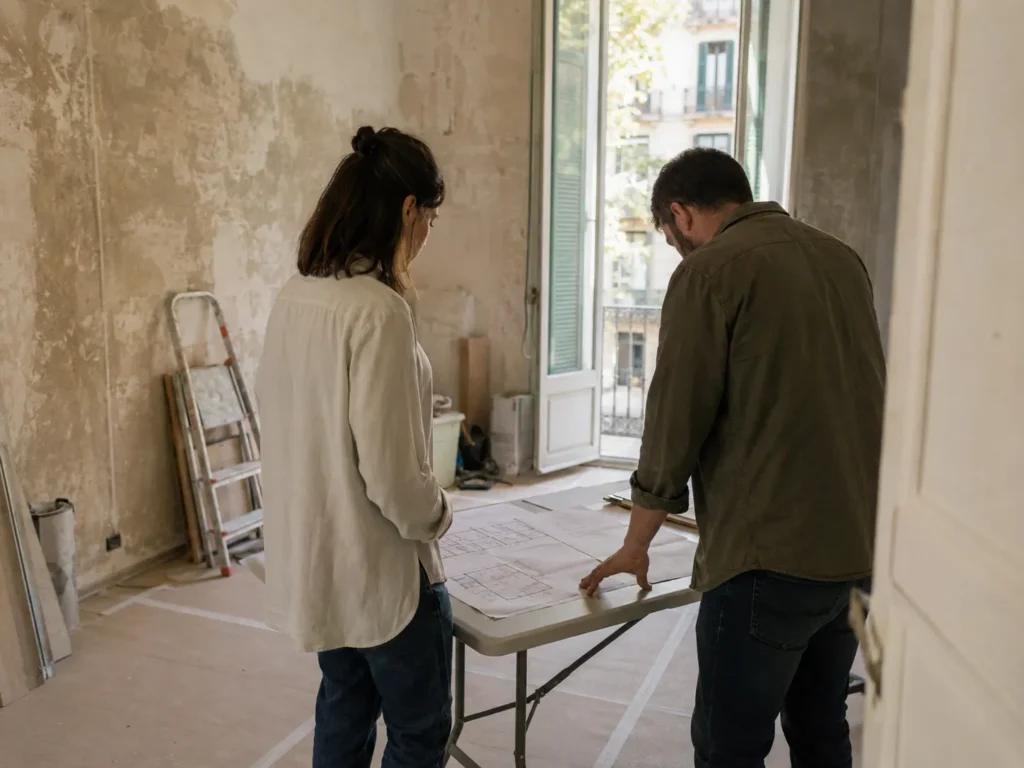
How to choose a renovation company in Barcelona: project manager reviewing itemised plans on an apartment renovation site
Home » Guides » How to Choose a Renovation Company in Barcelona: A Checklist for Overseas Owners

The good news is that Spain gives you more public, verifiable information about a construction company than most countries do. Registration, insurance, tax standing and even sector-specific accreditation can all be checked before you sign anything. This guide sets out what to verify, what a proper quote looks like, how to structure payments, and what recourse you have if it goes wrong.

Key Checks at a Glance

Legal existence: a valid CIF, filed accounts at the Registro Mercantil, and registration in the Registro de Empresas Acreditadas (REA) — legally required for any company working on a construction site.
Insurance: current civil liability cover, with the policy number and sum insured stated in writing.
Statutory liability: Spanish law sets liability periods of 10, 3 and 1 year depending on the type of defect.
The quote: itemised by trade with measurements and unit prices — never a single lump sum.
VAT: most dwelling renovations qualify for 10% instead of 21%. Getting this wrong is expensive.
Payments: staged against completed milestones, never front-loaded, always to a company account.

Why Hiring From Abroad Is a Different Problem

When something goes wrong on a renovation managed remotely, it is rarely because the tiling was poor. It is because nobody was there to notice a decision being made, because the quote said “bathroom refurbishment — €14,000” and nobody could argue about what that included, or because the money had already been paid before anyone questioned the work.

Distance turns ordinary problems into unrecoverable ones. So the checks below are less about identifying a good builder and more about making sure you retain leverage and recourse the entire way through.

Step 1: Verify the Company Legally Exists

The CIF and the Registro Mercantil

Every Spanish company has a CIF (tax identification code). Ask for it in writing, along with the full registered company name — which is often not the trading name on the website. You can then check the company at the Registro Mercantil Central, which shows whether it is properly incorporated and whether it files annual accounts. A construction company that has never filed accounts, or whose registered name does not match its invoices, is a company you cannot pursue later.

The REA — the register specific to construction

This is the check almost nobody outside the industry knows about. Under Spanish subcontracting law, any company that intends to be contracted or subcontracted to work on a construction site must be registered in the Registro de Empresas Acreditadas (REA) with the labour authority where its registered office is located. It is not optional and it is not a trade badge — it is a legal requirement, and the register is public.
Ask for the company’s REA number. A builder who cannot produce one either does not know their own legal obligations or is not meeting them. Neither is a good sign.

Tax and social security clearance

Ask for a certificado de estar al corriente from both the Agencia Tributaria and the Seguridad Social. These certify that the company has no outstanding tax or social security debts. They are free, obtainable electronically in minutes, and a legitimate company will not hesitate. The reason this matters to you: a contractor with social security debts may have workers on your site who are not properly registered, and that becomes your problem if there is an accident.

Step 2: Check the Insurance That Actually Covers You

01

Civil liability

Ask for the seguro de responsabilidad civil certificate — not a verbal assurance. You want the insurer’s name, the policy number, the sum insured and the expiry date, and you want the policy to be current for the whole period of your works. This is what responds if your contractor floods the flat below yours, which in a dense Barcelona building is not a hypothetical.

02

What the law guarantees you: 10, 3 and 1 year

Spain’s Ley 38/1999 de Ordenación de la Edificación (LOE) sets out how long building agents remain liable for defects, on a three-tier scale:
· 10 years — material damage caused by defects affecting structural elements. For new residential buildings this is backed by compulsory seguro decenal.
· 3 years — damage to constructive elements or installations affecting the habitability of the property.
· 1 year — defects in finishing and execution.

Ask any prospective contractor to confirm, in writing, which of these periods they consider applicable to your scope and what their insurance actually covers. The compulsory decenal policy is tied principally to new-build housing, so on a renovation the meaningful protection is the contractor’s own civil liability cover plus their contractual warranty. A company that gives you a clear, specific answer here is a company that has thought about it.

Step 3: Read the Quote Like a Professional

Itemised measurements, not a single number

A professional Spanish quote is a presupuesto por partidas: each trade broken into line items, each with a quantity, a unit and a unit price. “Demolition — 42 m² at €18/m²” can be checked, challenged and compared. “Works — €38,000” cannot.
Insist on it. If only one of three quotes is itemised, you are not comparing like for like, and the totals will not mean what you think they mean. Our guide to apartment renovation costs in Barcelona sets out the ranges each trade should fall within.

The VAT detail that costs owners thousands

Renovation work on a dwelling can be invoiced at the reduced 10% VAT rate instead of 21%, but only if three conditions are met simultaneously:

1. The property is used as a private dwelling, not for an economic activity;
2. At least two years have passed since construction was completed;
3. The cost of materials supplied by the contractor does not exceed 40% of the total taxable base.

That third condition is the one that catches people. If materials exceed 40%, the operation is reclassified and the entire job is taxed at 21%. On a €50,000 renovation, the difference between the two rates is €5,500 — which is why the applicable rate should be stated explicitly on the quote, not discovered on the final invoice. Age can be evidenced with the escritura, a Catastro record or the first occupancy licence.

What should be explicitly excluded

Ask what the quote does not include. Permit fees, the ICIO construction tax, architect or technical director fees, waste removal, and provisional site utilities are the usual omissions. A quote that excludes them silently is not cheaper — it is just incomplete. Our Barcelona renovation permits guide explains which fees apply to which category of work.

Step 4: Structure the Payments to Protect Yourself

Payment structure is your only real leverage once work begins. From abroad, it matters more than anywhere.

Never pay a large deposit. A modest advance to secure materials and scheduling is normal; half the contract value up front is not.

Tie payments to completed milestones, not to dates. “On completion of first fix, verified by photographic report” beats “30 days after start”.

Hold a retention — commonly around 5% — until snagging is signed off.

Pay only into a company bank account matching the CIF on the invoice. Never to a personal account, and never to an account in a different country than the company.

Get a proper invoice (factura) for every payment, with the VAT rate shown. No invoice means no warranty claim, no deductible expense, and no proof.

Overseas owner reviewing a weekly photo progress report from a Barcelona apartment renovation on a laptop

AI-modified image

Step 5: Get the Contract Right Before You Sign

The contract should be a written document you have read in a language you understand, and it should name at minimum: the full scope with reference to the itemised quote, start and completion dates, penalties for delay, the payment schedule, how variations are priced and approved, the warranty period, and who the technical director is.

Two clauses matter disproportionately when you live abroad. First, variations: agree that no additional work proceeds without your written approval and an agreed price — this is where remote projects overrun. Second, communication: specify the reporting frequency and format you expect. Weekly photo reports are reasonable to demand and easy to provide.

If you cannot be present to sign documents or attend a community meeting, a poder notarial (power of attorney) lets a trusted representative act for you. It can be granted at a Spanish consulate in your country of residence, and it is worth arranging before you need it rather than during a delay.

Red Flags

A quote arrives as a single figure, or as a WhatsApp message
The company will not provide a CIF, a REA number or an insurance certificate
You are asked to pay into a personal account, or offered a discount for paying without an invoice
The company says permits are unnecessary, or offers to “start now and sort the paperwork later”
The VAT rate is not stated, or changes between quote and invoice
No named technical director for work that clearly requires one
Nobody at the company communicates fluently in a language you can hold a contract discussion in

If Something Goes Wrong: Your Recourse in Catalonia

Every business trading in Catalonia is legally required to hold official complaint forms (fulls oficials de queixa, reclamació i denúncia) and to provide them on request. They come in triplicate: one copy for you, one for the authorities, one for the company.

From there, a complaint goes to the municipal or district consumer office (OMIC/OCIC), or directly to the Agència Catalana del Consum. The authority then attempts mediation, and failing that, consumer arbitration — though arbitration requires the company to accept it, which is itself a reason to check in advance whether a contractor is adhered to the arbitration system.

It is worth knowing this route exists before you need it, and keeping every contract, invoice and progress report from day one — a complaint without documentation rarely goes anywhere.

Common Questions

Sources & References


· BOE — Ley 38/1999, de Ordenación de la Edificación — liability periods of 10, 3 and 1 year and the decenal insurance obligation: boe.es

· Agencia Tributaria — VAT rate applicable to works on dwellings (10% vs 21%) and the 40% materials rule: sede.agenciatributaria.gob.es

· Registro Mercantil Central — company incorporation and filed accounts: rmc.es

· Ministerio de Trabajo — Registro de Empresas Acreditadas (REA) — compulsory register for companies working on construction sites: mites.gob.es

· Seguridad Social — certificates confirming a company is up to date with contributions: seg-social.gob.es

· Agència Catalana del Consum — official complaint forms, mediation and consumer arbitration in Catalonia: consum.gencat.cat

· Ajuntament de Barcelona — ICIO tax on constructions, installations and works: ajuntament.barcelona.cat

Legal requirements and tax rates change — confirm current terms with the relevant authority or a professional adviser before contracting. This article is informational and is not legal, tax or financial advice. Last updated: August 2026.

Looking for a Renovation Company in Barcelona?

We work almost exclusively with owners who live somewhere else, and we expect clients to run these checks on us. Ask and we will send our registration details, insurance certificate and an itemised quote before you commit to anything — and you can read more about the company and its track record first..

Scroll to Top