Energy-Efficient Renovation in Barcelona: A Guide for Non-Resident Owners

An energy-efficient renovation in Barcelona is rarely why you bought the flat. It becomes a priority when your tenant complains about January, your electricity bill looks nothing like you expected, and your energy certificate comes back with an F on it.

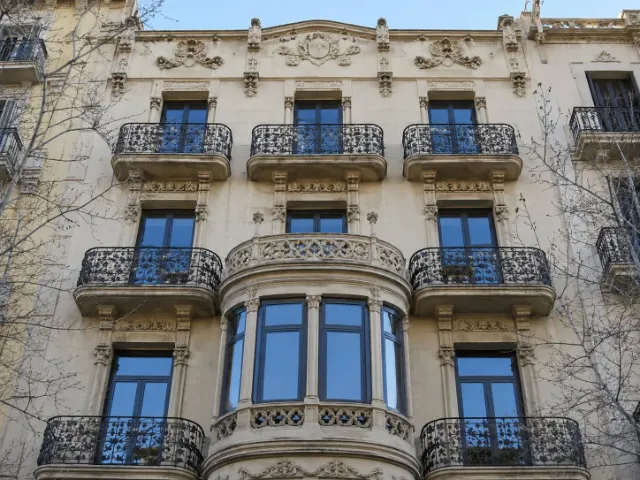
Energy-efficient renovation in Barcelona: Eixample apartment building with newly installed thermal-break windows
Home » Guides » Energy-Efficient Renovation in Barcelona: A Guide for Non-Resident Owners

Barcelona has the oldest housing stock of any major Spanish city: 84.5% of its homes are at least 40 years old, well above the provincial average. Most of those buildings went up before Spain had meaningful thermal regulation. The result is a city full of beautiful flats that leak heat in winter and trap it in summer.

This guide covers what actually works in a Barcelona flat, what the grants pay for, and — the part almost nobody writes about in English — which subsidies a non-resident owner can and cannot claim. Everything is sourced from the Ajuntament, the Consorci de l’Habitatge de Barcelona and Spanish national law, with links so you can verify it.

Key Facts at a Glance

The essentials of an energy-efficient renovation in Barcelona, before the detail:

Grant value: up to €6,000 per dwelling — 40% of works cost from Next Generation EU funds (capped at €3,000) plus a €3,000 municipal top-up.

Minimum spend to qualify: €1,000.

Proof required: a 7% cut in heating and cooling demand, a 30% cut in non-renewable primary energy, or an envelope meeting CTE DB HE-1 limits.

The catch for overseas owners: the flat must be someone’s registered habitual residence — an empty second home does not qualify, but a let flat with a registered tenant does.

Energy certificate: legally required to sell or let; valid 10 years, or 5 years if rated G.

Why Barcelona Flats Lose So Much Energy

Two dates matter. Spain’s first thermal building regulation arrived in 1979; the Código Técnico de la Edificación (CTE), which set modern standards, only became mandatory in 2006. Roughly 45% of Spanish residential buildings predate 1980, and more than 80% of Spanish homes are rated E, F or G — the bottom three grades of a seven-point scale.

In Barcelona, the typical pre-war finca in the Eixample, Gràcia or El Born has a recognisable set of weaknesses:

Single-leaf brick façades

with no cavity and no insulation layer

Original timber or early aluminium windows

with no thermal break and single glazing

Interior rooms facing a pati de llums

(light well) that get almost no solar gain in winter

Uninsulated party walls and ceilings

especially in ground-floor and top-floor flats

Poor airtightness

Barcelona’s older walls are prone draughts around window frames, blind boxes and service risers

None of this makes a Barcelona flat a bad asset. It does mean generic advice written for a British semi or a German apartment block will send you in the wrong direction.

Energy-Efficient Renovation in Barcelona: The Upgrades That Move the Needle

1. Insulation — and why it usually goes on the inside

External insulation systems (SATE) are technically superior: they wrap the building and eliminate thermal bridges. In practice, most Barcelona owners cannot use them. Façades are shared property, many are architecturally protected, and external work needs the agreement of the whole building.
That leaves internal insulation, applied to the inside face of the exterior walls. It costs a few centimetres of floor area per room and must be detailed carefully to avoid condensation, but it is the realistic route for a single flat. Insulating the floor slab and ceiling matters too if you are on the ground or top floor. Our insulation team in Barcelona handles the specification and condensation risk analysis at design stage.

2. Windows and thermal bridges

Windows are usually the highest-impact change in a Barcelona flat, because they fix heat loss, noise and draughts at once — and street noise is a genuine problem in the Eixample. Look for double glazing with a thermal break in the frame, and pay attention to how the frame meets the wall. A high-performance window fitted into an uninsulated reveal loses much of its benefit.
One planning point: if the window changes the appearance of the façade, it stops being a purely internal job. See the permits section below.
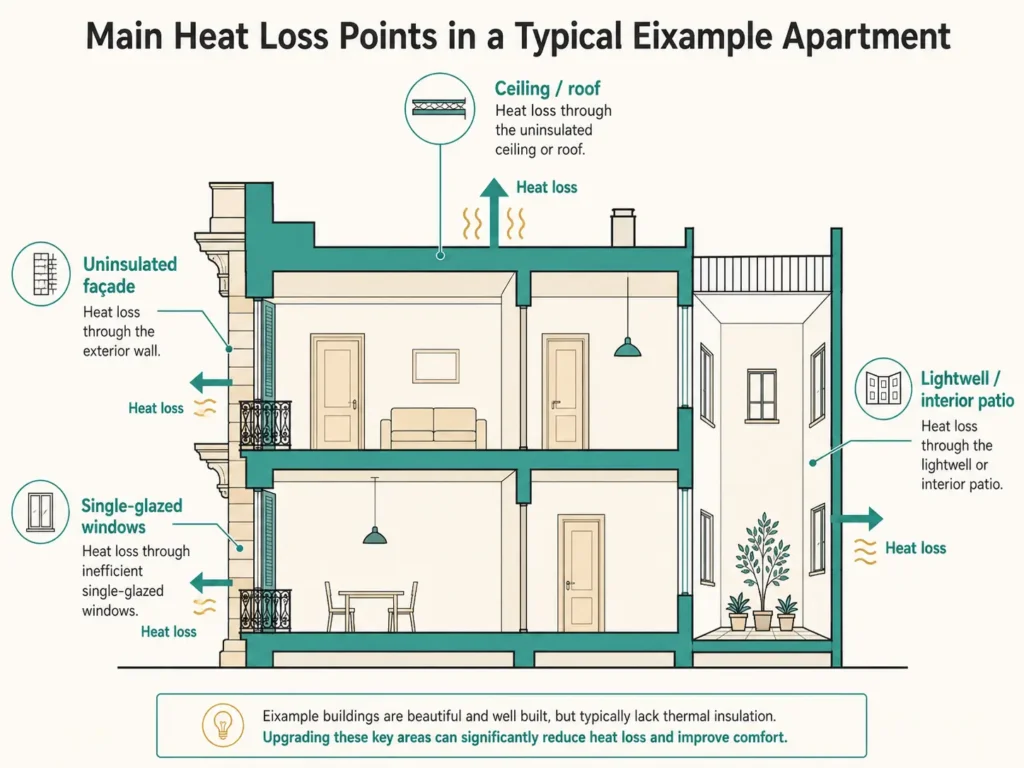
Diagram showing where a typical Barcelona apartment loses heat: uninsulated façade, single-glazed windows, roof and light well

3. Heating and cooling: aerotermia

Aerotermia — air-source heat pump technology — has become the default recommendation for sustainable renovation in Barcelona, for a specific reason: it covers heating, cooling and domestic hot water from one system, and counts as renewable energy under Spanish rules. That matters for grants, because subsidies explicitly exclude thermal generators running on fossil fuels. Replacing a gas boiler with another gas boiler qualifies for nothing.

4. Ventilation with heat recovery

Once you insulate and seal a flat, you must ventilate it deliberately, or you get condensation and poor air quality. Mechanical ventilation with heat recovery brings in fresh air while retaining most of the heat from the air it expels. It is the step owners most often skip and most often regret, particularly in interior bedrooms facing a light well.

5. What to do last, not first

LED lighting and efficient appliances are worth doing, but they are finishing touches. They do not change the fabric of the building, and alone they will not shift your energy rating or qualify you for a fabric-based grant. Do the envelope first.
Grants: What Non-Residents Can and Cannot Claim

This is where most English-language advice goes quiet, and where the money is.

The Consorci de l’Habitatge de Barcelona runs the main subsidy for eco-friendly remodeling in Barcelona homes, funded jointly by Next Generation EU money and a municipal top-up:

Up to €6,000 per dwelling, never exceeding the total cost of the works

40% of the works cost from Next Generation EU funds, capped at €3,000, plus a €3,000 municipal complementary subsidy

Minimum works cost of €1,000 to qualify at all

If your building already has a building-level grant file open, the dwelling-level cap drops to €3,000

To qualify, the work must achieve at least one of the following, proven by comparing the energy certificate before and after:

A reduction of at least 7% in annual heating and cooling demand, or

A reduction of at least 30% in non-renewable primary energy consumption, or

Replacement of thermal envelope elements meeting the transmittance and air-permeability limits in the CTE’s DB HE-1 document

The residency condition — read this twice

Here is the clause that catches out overseas owners. The regulations require that the dwelling “must constitute the habitual and permanent residence of its owners, usufructuaries or tenants at the time of submitting the application”, evidenced by a certificado or volante de empadronamiento — the municipal residence registration.

That sentence contains both the trap and the way through it:
If your Barcelona flat sits empty as a second home, you do not qualify. There is no habitual resident to register.
If your flat is let to a tenant registered at that address, it can qualify — because the rules name owners, usufructuaries and tenants as eligible beneficiaries, and accept the tenant as the habitual resident.

For a non-resident landlord, that distinction can be worth €6,000. It is also a strong argument for sequencing your renovation and your letting correctly, rather than leaving the flat vacant “until the works are finished”.

Timing: where the grant calls currently stand

Treat any article quoting a grant deadline without a date attached with suspicion. The dwelling-level call (Programa 4) ran until 30 June 2026, or until funds were exhausted, and that window has closed. Building-level programmes run on their own calendars and conditions — notably, the building must be predominantly residential and hold a valid ITE (Inspecció Tècnica de l’Edifici, the mandatory technical building inspection).

New calls are published periodically. Before committing to a scope, check current status with the Barcelona City Council housing service or the Oficina de Rehabilitació Municipal, which also runs an official grant simulator. Applications are processed in order of submission, so preparation matters more than the speed of any decision.

The Energy Certificate You Will Need Anyway

The certificado de eficiencia energética (CEE) is not optional paperwork. Under Royal Decree 390/2021, it is mandatory to sell or rent any dwelling in Spain, and must be registered with the competent body of the autonomous community — in Catalonia, the Institut Català d’Energia (ICAEN).

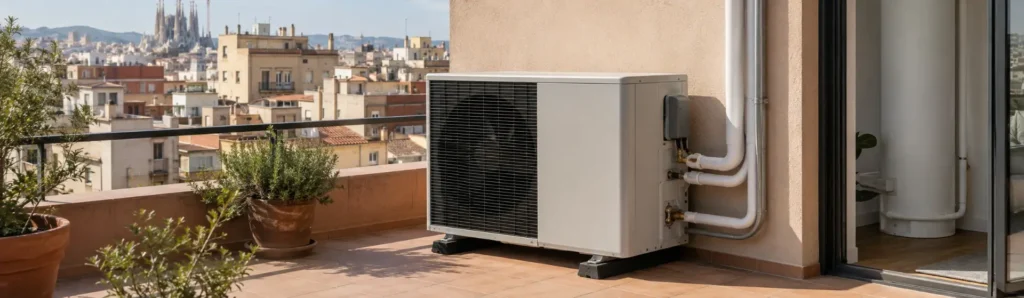
Aerotermia air-source heat pump installed on a Barcelona apartment terrace providing heating, cooling and hot water

AI-modified image

Two details owners routinely get wrong:

Pale, consistent colours across walls, floor and fixtures blur the room’s boundaries and make it feel larger. Sharp contrasts chop a small room into pieces.

A wall-to-wall or oversized mirror is the cheapest way to double the sense of space and bounce light around. A mirrored cabinet does the same job and adds hidden storage.

The certificate does three jobs at once: legal compliance for letting, proof of improvement for the subsidy, and a rating any prospective tenant or buyer will see. Commission the “before” certificate early — not after the builders arrive.

Your Neighbours Have a Vote

A permit from the Ajuntament is not the only permission you need. In a Spanish apartment building, the façade, roof, structure and external appearance of windows are elementos comunes — common elements belonging to the comunidad de propietarios, governed by the Horizontal Property Law. In practice:

Building-level grants can only be pursued by the community, not by you alone — which means persuading neighbours who may not share your timetable.

Anything touching the façade, the roof, or the external look of your windows generally requires approval at a junta, recorded in the minutes.

Insulating the inside face of your own walls is private work and your decision alone.

Owners abroad consistently underestimate this step. A junta may meet once a year unless someone calls an extraordinary meeting, and you will usually need someone physically present to represent you.

Permits: What You Need Before Starting

Energy work spans the full range of Barcelona’s permit system. Replacing a boiler with a heat pump, or insulating internally, typically falls at the lighter end. Changing windows visible from the street, or anything touching the façade or structure, escalates quickly — and heritage-protected buildings have their own rules.

Getting this wrong is expensive: unpermitted work can mean fines, a suspension order, and problems at resale when a buyer’s lawyer reviews the file. Our Barcelona renovation permits guide sets out which category your project falls into, what each costs and how long it takes.

Managing an Energy-Efficient Renovation From Abroad

An energy retrofit has more moving parts than a cosmetic refurbishment: a technician issuing certificates before and after, a community that must agree to some of it, a permit filing, a grant application processed in order of submission, and trades whose sequence genuinely matters — insulate, then seal, then ventilate, then finish.

That coordination is the whole job when you are not in the country — which makes choosing the right contractor the decision everything else rests on. Most of our clients live abroad and complete their projects without visiting the site, working from weekly photo reports and a single English-speaking point of contact. You can see the full range of home renovation services in Barcelona we deliver, or read what a full apartment renovation costs in Barcelona if you are budgeting a wider project.

Common Questions

Sources & References


· Consorci de l’Habitatge de Barcelona — grant amounts, eligibility, the habitual-residence requirement and qualifying works: consorcihabitatge.barcelona

· Ajuntament de Barcelona — Housing — grant lines, the Oficina de Rehabilitació Municipal and grant simulator: habitatge.barcelona

· Ajuntament de Barcelona — Energia — municipal retrofit guidance: energia.barcelona

· BOE — Real Decreto 390/2021 — energy performance certificate: obligation to sell or let, validity and registration: boe.es

· MITECO — official summary of the energy certification procedure: miteco.gob.es

· Código Técnico de la Edificación — DB HE — transmittance and air-permeability limits cited in the grant conditions (tables 3.1.1.a, 3.1.3.a): codigotecnico.org

· Ajuntament de Barcelona — Urban Planning — permit types, online filing and processing times: ajuntament.barcelona.cat

· Generalitat de Catalunya — Inspecció Tècnica de l’Edifici (ITE), required for building-level grants: gencat.cat

· Housing-stock age and energy-rating data, from published national and Catalan sources.

Grant amounts, deadlines and eligibility change between calls — confirm current terms with the Oficina de Rehabilitació Municipal before applying. Informational only; not tax, legal or technical advice. Exact figures require a site survey and an itemised quote.
Last updated: August 2026.

Planning an Energy-Efficient Renovation in Barcelona?

No two buildings behave alike, and the right scope for an energy-efficient renovation in Barcelona depends on your flat’s orientation, floor level, façade construction and whether it is let. Tell us about the property and we will come back with a specification, an honest view on which permissions you need, and where your project stands against the current grant rules.

Scroll to Top